Project management is entering 2027 in a very different place from where it was just a few years ago. Artificial intelligence is moving from experimentation into everyday project work. Project Management Offices (PMOs) are being asked to demonstrate business value rather than simply enforce processes. Sustainability is becoming a delivery requirement while geopolitical uncertainty, regulatory change, complex stakeholder networks and rapid technology cycles are making projects harder to complete.
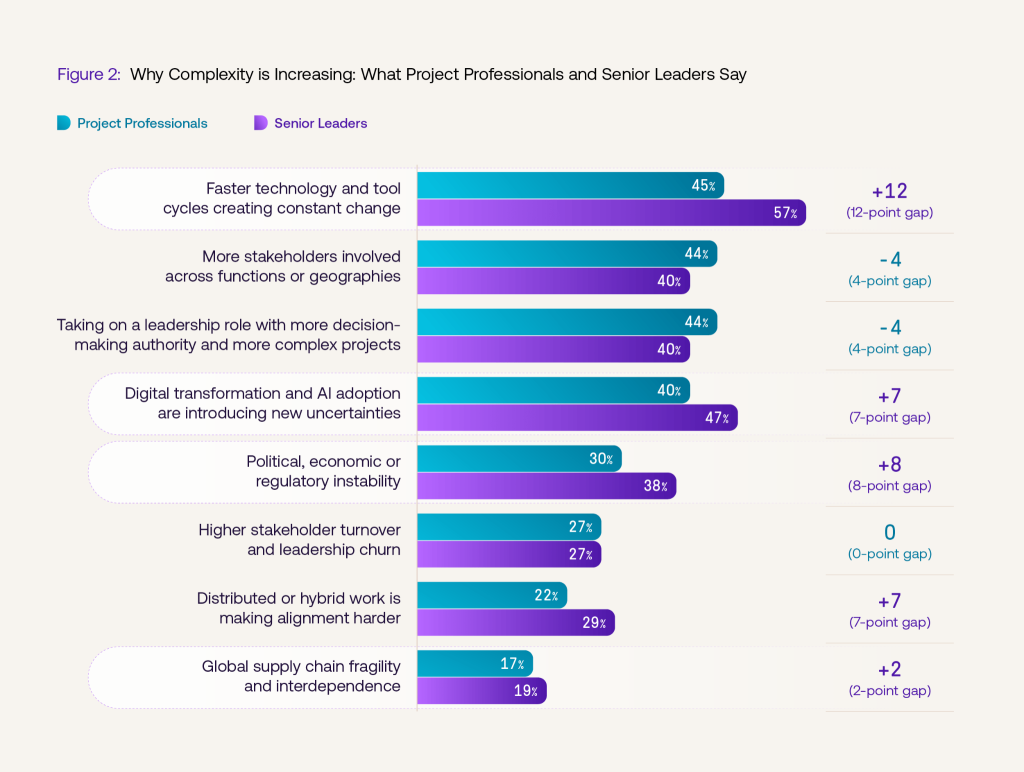
The evidence already visible in 2026 points toward a broader transformation: the project manager of 2027 will spend less time administering projects and more time orchestrating people, technology, decisions, risks and business outcomes. Project Management Institute (PMI) reports that 97% of project professionals managed at least one complex project in the previous year while teams that manage complexity effectively are five times more likely to achieve project success.
In this article, TaskQue will highlight ten project management trends you should keep an eye on in 2027.
10 Project Management Trends You Should Keep an Eye On in 2027
Here are ten project management trends worth watching in 2027.
1. AI Agents Will Become Part of the Project Team
By 2027, project teams are likely to work with AI agents capable of performing multi-step tasks rather than simply answering prompts. Instead of asking an AI assistant to summarize a status meeting, a project manager may have an agent identify project risks, update the Risks, Assumptions, Issues and Dependencies (RAID) log, analyze schedule variance, prepare stakeholder communications and recommend corrective actions. This represents an important shift from AI as a productivity tool to AI as a delivery participant.
McKinsey research shows that agentic AI adoption is growing, especially among large enterprises. Atlassian is developing multi-agent architectures capable of planning and executing increasingly complex tasks across tools and systems. Identify repetitive activities suitable such as action tracking, status reporting, schedule analysis, risk identification, resource forecasting, requirements analysis and project health reporting and automate them. The goal is not to automate the project manager out of existence but to remove administrative friction so project leaders can spend more time on judgment, leadership and decision-making.
2. AI Governance Will Become a Core Project Management Discipline
AI-generated outputs can introduce issues involving data privacy, intellectual property, cybersecurity, bias, hallucinations, regulatory compliance, accountability and operational risk. That is why responsible AI will become intertwined with project governance. PMI published The Standard for Artificial Intelligence in Portfolio, Program and Project Management, introducing principles for governing AI-enabled project work and AI-driven initiatives. The framework emphasizes human-in-the-loop oversight, ethical and legal guardrails, risk management and lifecycle governance.
This will be important in sectors such as financial services, healthcare, government, insurance, technology and critical infrastructure. The project manager will increasingly become the person connecting business objectives, technology teams, legal functions, cybersecurity, compliance and executive stakeholders.
3. Project Managers Will Shift From Task Managers to Outcome Leaders
Project success was associated with the triangle of scope, schedule and cost. Those metrics still matter but they are no longer enough. A project can be delivered on time and within budget while failing to create meaningful business value. This is why value realization, benefits management and strategic alignment will become important in 2027.
PMI’s research describes a shift from managing activities toward delivering outcomes while its research into project management officers highlights strategic alignment and value realization management as critical capabilities. The best project managers will understand business cases, benefits realization, ROI, customer outcomes and organizational strategy, not just project schedules and project management methodologies.
4. Project Management Offices Will Become Strategic Value Offices
The project management office is associated with governance, templates, reporting, standards and project controls. That model is evolving. The strategic PMO will increasingly function as an enterprise orchestration capability connecting strategy with execution. Project Management Institute identifies customer centricity, strategic alignment and data and technology integration as important capabilities for modern PMOs.
5. Hybrid Project Management Will Become the Default
The debate between agile and waterfall is becoming irrelevant. Most organizations don’t operate in environments where one methodology fits every project. A software product may require scrum or kanban for iterative development while regulatory approvals, procurement or infrastructure components require predictive planning. Large transformation programs combine agile teams with traditional governance, stage gates and portfolio controls.
APM’s trend analysis specifically identifies hybrid delivery as important, especially for complex projects where adaptability needs to coexist with governance and compliance. In 2027, experienced project managers will be expected to tailor the delivery model to the project rather than blindly applying a methodology.
6. Predictive Project Analytics Will Move From Reporting to Decision Support
Project data is used to answer many questions, which will accelerate the adoption of predictive project management. Instead of waiting for a milestone to be missed, intelligent project management platforms can analyze historical performance, dependencies, resource utilization, schedule variance and other signals to identify emerging problems.
APM research highlights the movement toward data-driven project decisions and AI-supported scenario modeling. The project manager’s dashboard will be less about colorful status indicators and more about decision intelligence.
7. Complexity Management and Systems Thinking Will Become Essential Skills
Projects are becoming interconnected systems rather than isolated pieces of work. A technology project can depend on cybersecurity, procurement, data architecture, regulatory approval, organizational change and customer adoption. A construction project can be affected by supply chains, energy prices, environmental requirements, government policy and geopolitical developments.
PMI’s Pulse of the Profession found that 81% of project professionals believe projects have become more complex and that professionals who effectively navigate complexity are five times more likely to deliver successful projects. This makes systems thinking one of the most valuable project management capabilities for 2027.
8. Sustainability Will Move From Strategy Statement to Project Requirement
Sustainability is now embedded in project decision-making. This extends beyond environmental sustainability. Modern project teams increasingly need to consider ESG, climate resilience, social value, resource efficiency, responsible procurement and long-term impact. Project Management Institute and Green Project Management research found that sustainability was the strongest predictor of project success in their research while 59% of organizations surveyed had not fully integrated sustainability at the project and functional level. That gap creates a major opportunity for project managers.
By 2027, sustainability will appear in:business cases, project selection, procurement, supplier evaluation, project key performance indicators and in investment decisions. A project manager needs to understand not only whether a project can be delivered but also what impact its delivery creates.
9. Human Skills Will Become More Valuable
One of the biggest misconceptions about artificial intelligence and project management is that technical automation will make human project managers less important. The opposite may happen. As artificial intelligence handles more administrative work, human capabilities such as leadership, communication, negotiation, emotional intelligence, influence, critical thinking, conflict resolution and stakeholder management become more valuable.
APM research emphasizes that AI cannot replace human judgment, ethical reasoning, organizational direction and the ability to understand the broader human context of projects. In 2027, a project manager will have to deal with a resistant business sponsor, two departments fighting over priorities, a team experiencing burnout, a customer changing requirements, an executive demanding an unrealistic deadline and a supplier failing to meet commitments.
Artificial intelligence can provide analysis but leadership is required to navigate the situation. This means that project managers will need a powerful combination of: AI literacy, business acumen, analytical thinking and interpersonal leadership.
10. Continuous Learning Will Become Part of the Project Manager’s Job
The project management profession is experiencing significant changes in technology, delivery methodologies, organizational structures, regulation and required skills. Consequently, a project management certification or methodology learned several years ago will not be enough on its own. PMI’s revised PMP examination, launched in July 2026, explicitly places greater emphasis on artificial intelligence, sustainability, stakeholder engagement, outcomes, value and business impact.
Research also points toward growing demand for digital skills, data literacy, technology adoption and people-centered leadership. Project management professionals should treat continuous professional development (CPD) as an ongoing capability instead of an annual compliance exercise.
Conclusion
Project management in 2027 won’t be defined simply by who can build the best Gantt chart, run the most effective stand-up or produce the most detailed status report. Those capabilities will remain useful but technology will automate parts of them. The differentiator will be judgment. The project manager of the future will need to know when to trust an AI recommendation, when to challenge it, when to change direction, how to align conflicting stakeholders, how to manage uncertainty and how to connect individual project decisions to broader organizational outcomes.
The most successful project professionals will combine human leadership with machine intelligence. Organizations that understand this shift will treat project management not simply as a mechanism for delivering initiatives but as a strategic capability for turning business strategy into measurable change. Which of these project management trends will create the biggest impact in 2027 in your opinion? Share it with us in the comments section below.